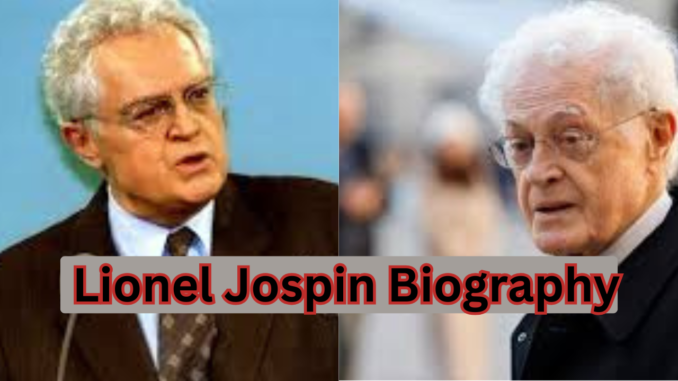
Biography
Lionel Robert Jospin was born on July 12, 1937, in Meudon, a suburb of Paris, France. He was raised in a Protestant family that valued discipline, education, and strong moral principles. His father, Robert Jospin, was a respected intellectual and political figure, which influenced Lionel’s early interest in politics and social issues.
As a young man, Jospin was deeply involved in student activism. During his university years, he participated in protests against the Algerian War, showing early signs of his commitment to justice and human rights. He studied at prestigious institutions such as Sciences Po and the École nationale d’administration, where many of France’s top leaders have been trained.
After completing his education, Jospin began his career in public service, joining the Ministry of Foreign Affairs. However, his true calling was politics. Over time, he became a leading figure in the French Socialist movement, shaping the future of the country’s political landscape.
Career
Lionel Jospin’s political career began in the 1960s when he joined a left-wing Trotskyist group before later becoming a member of the Socialist Party. His intelligence, discipline, and strong ideological beliefs quickly helped him rise through the ranks.
He became closely associated with François Mitterrand, one of France’s most powerful political leaders. Under Mitterrand’s influence, Jospin became a key member of the Socialist Party and eventually served as its First Secretary during important periods.
In 1981, when Mitterrand became president, Jospin was appointed as the First Secretary of the Socialist Party. He played a major role in shaping party policies and strengthening its national influence. Later, he served as Minister of National Education from 1988 to 1992, where he introduced important reforms in schools, universities, and teacher training.
His biggest political achievement came in 1997 when he became Prime Minister of France under President Jacques Chirac. This period was known as “cohabitation,” where the president and prime minister came from different political parties.
As Prime Minister, Jospin introduced many reforms that improved the lives of French citizens. One of his most famous policies was the introduction of the 35-hour workweek, which aimed to improve work-life balance and reduce unemployment. He also expanded healthcare access through universal medical coverage and increased social benefits for low-income families.
His government focused on reducing inequality, supporting education, and promoting social justice. During his time in office, unemployment decreased significantly, and the economy experienced steady growth.
Jospin also supported gender equality in politics, improved workers’ rights, and introduced laws to protect citizens from discrimination. His policies helped modernize France and strengthen its social welfare system.
In 1995 and 2002, Jospin ran for President of France. In 1995, he narrowly lost to Jacques Chirac in the final round. In 2002, he was unexpectedly eliminated in the first round after finishing behind both Chirac and Jean-Marie Le Pen. This shocking result led him to announce his retirement from active politics.
Despite stepping back, he returned to public service in 2015 when he was appointed to the Constitutional Council, one of France’s highest legal bodies. This role allowed him to continue contributing to the country’s governance.
Personal Life
Lionel Jospin was known for being a private and disciplined individual. He often appeared serious and reserved in public, which gave him a reputation as a thoughtful and focused leader.
He was married twice. His first marriage was to Élisabeth Dannenmuller, which ended in divorce. He later married Sylviane Agacinski, a respected philosopher and writer. Their relationship was built on shared intellectual interests and mutual respect.
Outside politics, Jospin enjoyed reading, writing, and engaging in intellectual discussions. He was deeply interested in philosophy, culture, and social issues, which influenced his political thinking.
Despite his high-profile career, he maintained a relatively simple lifestyle. He avoided unnecessary public attention and focused on his work and personal values.
His personality was often described as serious and disciplined, but those who knew him closely recognized his dedication and strong sense of responsibility.
Family
Lionel Jospin came from a well-educated and politically aware family. His father, Robert Jospin, played an important role in shaping his early beliefs and interest in politics.
He had children named Eva and Hugo, who remained an important part of his life. Despite his busy career, he maintained close relationships with his family and valued their support.
His second wife, Sylviane Agacinski, was also a key influence in his life. As a philosopher, she shared his interest in intellectual discussions and public affairs.
Jospin’s family life was marked by stability, respect, and strong values. He always balanced his responsibilities as a political leader with his role as a husband and father.
Cause of Death
Lionel Jospin passed away on March 22, 2026, in Paris, France, at the age of 88. His death came after he had undergone a major surgical procedure earlier in the year.
Although detailed medical information was not widely shared, it is known that his health had declined in his final months. He had been recovering at home following surgery before his passing.
His death marked the end of an era in French politics. Many leaders and citizens paid tribute to his contributions, remembering him as a man who dedicated his life to public service and social progress.
Net Worth
Lionel Jospin was not known for personal wealth in the way many business figures are. As a career politician, his income mainly came from his government roles and public service positions.
While exact figures are not widely confirmed, his net worth was considered modest compared to global political leaders. His focus throughout life was on public service rather than financial gain.
He lived a simple and disciplined lifestyle, reflecting his values of equality and social responsibility.
Age
Lionel Jospin was born on July 12, 1937, and died on March 22, 2026. He was 88 years old at the time of his death.
His long life allowed him to witness and influence major changes in French and global politics. His legacy continues to shape discussions around social justice, governance, and public policy.
Conclusion
Lionel Jospin’s life stands as a powerful example of dedication to public service and social reform. From his early days as a student activist to his time as Prime Minister of France, he remained committed to improving the lives of ordinary people.
His policies, including the 35-hour workweek and expanded healthcare access, had lasting effects on French society. Even after his retirement, his influence continued through his role in the Constitutional Council.
Jospin will always be remembered as a thoughtful leader who worked tirelessly for equality, justice, and progress. His legacy remains an important part of France’s political history.
FAQs
Who was Lionel Jospin?
Lionel Jospin was a French politician who served as Prime Minister of France from 1997 to 2002.
How old was Lionel Jospin when he died?
He was 88 years old at the time of his death in March 2026.
What is Lionel Jospin known for?
He is known for introducing the 35-hour workweek and expanding social welfare policies in France.
Did Lionel Jospin run for president?
Yes, he ran for president in 1995 and 2002 but did not win.
What was Lionel Jospin’s cause of death?
He passed away after health complications following a major surgery in 2026.
Tomson Charles is a journalist and writer who covers battery-material recycling, urban mining, and the growing use of microreactors in industry. With 10 years of experience in industrial reporting, he explains new technologies and industry changes in clear, simple terms. He holds both a BSc and an MSc in Electrical Engineering, which gives him the technical knowledge to report accurately and insightfully on these topics.
Leave a Reply