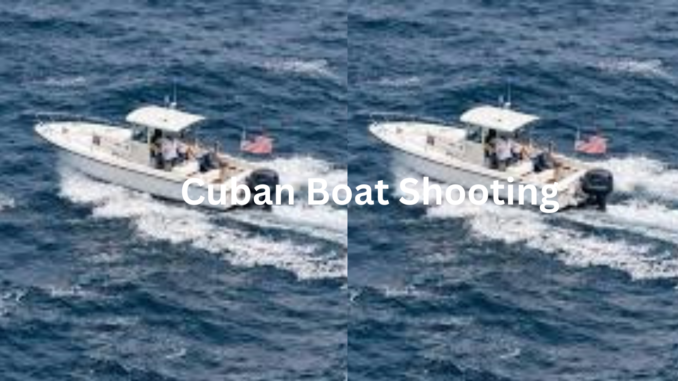
What Happened in the Cuban Boat Shooting Incident
The Cuban boat shooting occurred when Cuban security forces intercepted a Florida-registered speedboat that entered Cuban territorial waters near Falcones Cay, located off the northern coast of Villa Clara Province. According to Cuba’s Interior Ministry, the boat had traveled from Florida and crossed into Cuban waters without authorization.
Cuban border guard troops approached the speedboat to stop and inspect it. During this encounter, a passenger aboard the speedboat allegedly opened fire, wounding the commander of the Cuban patrol vessel. Cuban forces then returned fire.
As a result of the exchange, four people on the speedboat were killed. Six others were wounded and taken into custody. Cuban authorities stated that those onboard were Cuban residents living in the United States and that they were heavily armed. Weapons reportedly included assault rifles, handguns, and homemade incendiary devices.
Cuban officials described the incident as an attempted “armed infiltration” and claimed the group planned violent actions on the island. Medical treatment was provided to the injured survivors, who remain under Cuban custody.
Who Was Involved and What Cuba Claims
Cuba’s Interior Ministry said the individuals on the speedboat were not ordinary migrants. Instead, officials alleged the group intended to carry out acts of terrorism. Two of the surviving passengers were reportedly already wanted by Cuban authorities for previous terrorism-related cases.
The speedboat itself was registered in Florida, and maritime records link it to an older recreational vessel built in the early 1980s. Cuban authorities also said another individual inside Cuba had been arrested for helping prepare for the arrival of the armed group. That person reportedly confessed to assisting the plan.
The Cuban government emphasized that this was a national security issue, not a migration incident. Officials argued that their forces acted in self-defense after coming under direct gunfire.
Response from the United States and International Reactions
The United States government quickly responded after being notified of the shooting. US Secretary of State Marco Rubio said the speedboat was not part of any US government mission and was not carrying US officials.
American authorities, including the United States Coast Guard, began reviewing the incident to determine exactly what happened and whether any of the victims were US citizens or legal residents.
Several US lawmakers from Florida called for a full investigation. They raised concerns about the use of deadly force against a US-registered vessel and demanded transparency from Cuban authorities.
International observers noted that deadly shootouts at sea between Cuba and US-linked vessels are extremely rare. Even during past disputes, confrontations usually ended with arrests rather than fatalities.
News organizations, including CNN, highlighted the seriousness of the event and its potential diplomatic consequences.
Historical Tensions Behind the Cuban Boat Shooting
To understand why the Cuban boat shooting matters, it is important to look at the long and complicated history between Cuba and the United States.
For decades, relations between the two countries have been marked by mistrust, sanctions, and political hostility. The US economic embargo has heavily affected Cuba’s economy, leading to shortages of food, fuel, and basic supplies.
Tensions increased further after the US government, under President Donald Trump, tightened restrictions on Cuba and openly supported regime change. Cuba, in turn, accused the US of encouraging unrest and economic pressure.
The recent incident also occurred close to the anniversary of a major past tragedy involving Brothers to the Rescue, when Cuban forces shot down two civilian aircraft in 1996, killing four people. That event still influences US-Cuba policy today.
Cuba has also reported repeated encounters with speedboats allegedly involved in smuggling or human trafficking. In 2022 alone, Cuban authorities said they intercepted multiple US-linked boats attempting illegal operations.
Why the Cuban Boat Shooting Is So Significant
This incident stands out for several reasons. First, it involved direct gunfire at sea, which is extremely uncommon in the region. Second, it resulted in multiple deaths, raising the stakes politically and emotionally.
Third, it highlights the desperation and risks tied to US-Cuba relations. Nearly one million Cubans have left the island in recent years, many attempting dangerous sea journeys. While most are migrants seeking a better life, this case shows how easily migration, security, and politics can collide.
The Cuban boat shooting also raises serious legal questions. Who had the right to use force? Were international maritime laws followed? Were all options for peaceful interception exhausted? These questions will likely be debated for months.
Finally, the incident may affect future cooperation between Cuban and US authorities on migration, security, and maritime safety.
Conclusion
The Cuban boat shooting was not just a tragic clash at sea. It was the result of deep political tension, long-standing mistrust, and growing pressure on both sides of the Florida Straits. Four lives were lost, families were changed forever, and diplomatic relations were tested once again.
As investigations continue, the world will watch closely to see whether this incident leads to accountability, further conflict, or renewed dialogue. Understanding the full context helps explain why this single event matters far beyond Cuban waters.
FAQs
What caused the Cuban boat shooting?
Cuban authorities say the shooting happened after armed passengers on a speedboat fired first at Cuban border guards during an unauthorized entry into Cuban waters.
Was the speedboat part of a US government operation?
No. US officials confirmed the vessel was not linked to any US government mission.
Where exactly did the incident take place?
The shooting occurred near Falcones Cay, off Cuba’s northern coast in Villa Clara Province.
Were the people on the boat migrants or attackers?
Cuba claims they were armed individuals planning a violent infiltration, not ordinary migrants. The US is still reviewing the case.
Could this incident affect US-Cuba relations?
Yes. Experts believe it could increase tensions, especially if investigations reveal legal or diplomatic violations.
Tomson Charles is a journalist and writer who covers battery-material recycling, urban mining, and the growing use of microreactors in industry. With 10 years of experience in industrial reporting, he explains new technologies and industry changes in clear, simple terms. He holds both a BSc and an MSc in Electrical Engineering, which gives him the technical knowledge to report accurately and insightfully on these topics.
Leave a Reply