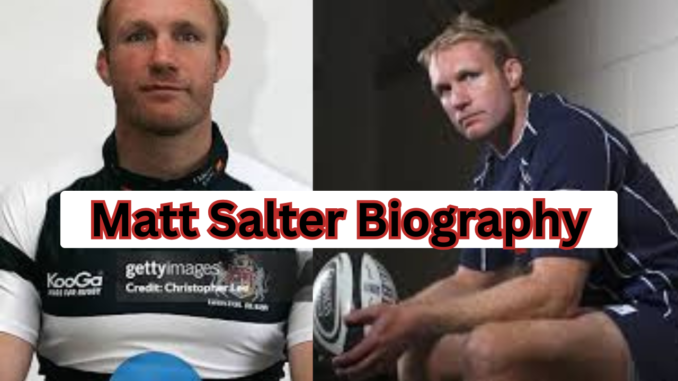
Biography
Matt Salter was born Matthew Salter on December 2, 1976, in Greenwich. Growing up in London, he developed an early interest in sports, particularly rugby. His physical strength and height made him naturally suited to the demanding nature of the sport.
Salter attended St Dunstan’s College, where he began to take rugby more seriously. During his school years, he developed important skills such as tackling, teamwork, and game awareness. Coaches quickly noticed his potential, and he soon became one of the promising young players in the school’s rugby program.
Later, he also studied at Clifton College, where he continued to improve his rugby abilities. His performances during his youth years helped him gain opportunities to represent regional and national youth teams.
One of the early highlights of his career came when he represented England Schools, playing in the back row against a touring New Zealand team. Competing against strong international opposition helped him gain valuable experience and confidence.
As a young athlete, Salter displayed both determination and discipline. These qualities would become important throughout his professional career, helping him earn the respect of teammates, coaches, and fans.
Career
Matt Salter’s professional rugby career began in the mid-1990s when he joined Blackheath F.C. for the 1995–96 season. He played in National League 2 South, making his debut against London Irish.
During his early career, Salter also explored rugby league, switching codes to gain more professional opportunities. He joined London Broncos, where he played from 1997 to 1999. During this period, he appeared in 57 matches and represented Great Britain Under-19s, showcasing his talent at an international youth level.
One of the most notable moments of his rugby league career came during the 1999 Challenge Cup Final. Salter played in the starting lineup for the London Broncos in the match held at Wembley Stadium. The team was famously led onto the field by entrepreneur Richard Branson, who supported the club at the time.
Despite a strong start by the Broncos, they were defeated by Leeds Rhinos, who secured a 52–16 victory. Even though the result was disappointing, the match remains a memorable moment in Salter’s career.
Salter later returned to rugby union, where he achieved his greatest success with Bristol Rugby. He first joined the club in 1999, beginning a long and influential association that lasted until 2009.
During his time at Bristol, Salter became known as a powerful forward who could dominate physical contests. His leadership qualities eventually led to him being named team captain, a role he held from 2004 to 2008.
Under his leadership, Bristol became a strong competitor in the Guinness Premiership, one of the top rugby union leagues in England. In 2006, Salter was selected as the captain of the Guinness Premiership Dream Team, a recognition given to outstanding players in the league.
Throughout his Bristol career, he played over 150 matches across two spells with the club. His performances made him a fan favorite and a respected figure within English rugby.
He also spent the 2003–2004 season with Leeds Tykes, where he added further experience before returning to Bristol.
After a decade of playing at the highest level, Salter retired from professional rugby in 2009.
Personal Life
While Matt Salter was widely known for his rugby career, he was also admired for his personality and leadership off the field.
Friends and teammates often described him as someone who was confident, hardworking, and deeply committed to the sport. As captain of Bristol Rugby, he earned a reputation for motivating players and setting high standards during training and matches.
Following his retirement from professional playing, Salter chose to remain involved in rugby through coaching and youth development.
From 2009 to 2011, he served as a coach for the Bristol Rugby Academy, where he worked with young players who hoped to build professional careers in the sport.
Later, he became the Head Coach at Clifton Rugby Club, an important community rugby organization in Bristol. His role there involved mentoring players, organizing training programs, and helping the club compete at a higher level.
Salter also took on a leadership role at Clifton College, where he worked as Director of Rugby. In this position, he helped guide young students interested in rugby and ensured that the sport continued to grow within the school.
Through coaching and education, he influenced many young athletes who admired his experience and leadership.
Cause of Death
Matt Salter passed away in March 2026, at the age of 49. News of his death was announced on March 7, 2026, and quickly spread throughout the rugby community.
At the time of the announcement, the exact cause of death was not publicly disclosed. However, many former teammates, clubs, and rugby organizations expressed deep sadness over the loss.
Tributes were shared by players, coaches, and supporters who remembered Salter as a respected leader and dedicated professional.
Clubs connected to his career, especially Bristol Rugby and Clifton Rugby Club, honored his memory and highlighted his contributions both on and off the field.
His death marked the loss of a player who had devoted much of his life to the development and success of rugby in England.
Age
Matt Salter was born on December 2, 1976, and passed away in March 2026.
At the time of his death, he was 49 years old.
Although his life ended relatively early, his achievements in rugby—both as a player and a coach—left a lasting legacy in English rugby.
Family
Information about Matt Salter’s immediate family has largely remained private. Unlike many public figures, he maintained a relatively low profile regarding his personal family life.
However, it is clear that he had strong connections within the rugby community, which often functions like an extended family. Many players who worked with him described him as a supportive mentor and friend.
His influence extended beyond teammates to include students, young players, and fellow coaches who benefited from his experience and guidance.
Even though public details about his relatives are limited, the respect shown by the rugby world demonstrates how much he meant to those who knew him.
Conclusion
Matt Salter’s life was defined by dedication, leadership, and a deep love for rugby. From his early days playing school rugby in London to becoming captain of Bristol Rugby, he built a career based on hard work and determination.
His success as a player, including appearances in major competitions and recognition in the Premiership Dream Team, demonstrated his talent and commitment to excellence.
After retiring from professional rugby, he continued to give back to the sport through coaching and mentoring young athletes. His work at Bristol Academy, Clifton Rugby Club, and Clifton College helped shape the next generation of players.
Although Matt Salter passed away in 2026 at the age of 49, his legacy remains strong within the rugby community. His contributions to the sport, both on the field and in coaching roles, will continue to be remembered for many years.
FAQs
Who was Matt Salter?
Matt Salter was an English rugby union and rugby league player who played primarily for Bristol Rugby and also represented the London Broncos.
How old was Matt Salter when he died?
Matt Salter was 49 years old when he passed away in March 2026.
What position did Matt Salter play in rugby?
He mainly played as a flanker or second row forward in rugby union and as a second-row forward in rugby league.
What teams did Matt Salter play for?
He played for clubs including Blackheath, London Broncos, Bristol Rugby, and Leeds Tykes during his professional career.
Did Matt Salter become a coach after retiring?
Yes. After retiring in 2009, he coached the Bristol Rugby Academy, later becoming Head Coach at Clifton Rugby Club and Director of Rugby at Clifton College.

Tomson Charles is a journalist and writer who covers battery-material recycling, urban mining, and the growing use of microreactors in industry. With 10 years of experience in industrial reporting, he explains new technologies and industry changes in clear, simple terms. He holds both a BSc and an MSc in Electrical Engineering, which gives him the technical knowledge to report accurately and insightfully on these topics.
Leave a Reply